Business License

CNC Wire Cutting vs Manual Wire Cutting: What Changes in the Part
The part is not the point of difference between a manual wire cutting machine and one with wire cutting machine cnc control. The difference is how many decisions the operator makes per hour, and what happens to the work when those decisions vary.
A manual machine cuts an accurate part when a skilled hand is on the crank. A machine under wire cutting machine cnc control cuts the same part on the first attempt and again on the four hundredth. This comparison looks at where that gap actually shows up in the workpiece.
1. What Changes When a Wire Cutting Machine Gets CNC Control
On a manual wire cutting machine, the operator reads a dimension from a drawing, turns a handwheel and watches a dial. The cut happens while that person is standing there, and the quality of the part is bounded by their attention at that moment.
Under wire cutting machine cnc control, the same geometry arrives as a program. The controller drives the table through a path it has already computed, and the operator's job shifts from executing the cut to preparing and verifying it.
Three things follow from that shift. Setup time moves earlier in the process, the run becomes indifferent to operator fatigue, and errors move from the part to the screen where they cost less.
Suzhou Excellence Intelligent Technology Co Ltd puts the difference in plain terms for buyers weighing both machine types. On the manual machine the operator is part of the cutting process, while on a controlled machine the operator stands outside it and can therefore check the work while it runs.
2. Where Wire Cutting Machine Manual Operation Still Holds Its Ground
A wire cutting machine manual operation makes sense in fewer places than its defenders claim, but it is not dead. Repair work on a single part with no drawing, where the operator is fitting to a physical mating surface, still favours a handwheel.
The other surviving case is the shop cutting one or two unusual parts a month on a machine that is already paid for. Programming time for a one-off can exceed the cutting time, and a skilled hand may finish first.
Everything above that volume tilts toward control systems. The crossover usually arrives around five identical parts, where the setup cost per part falls below the manual execution cost.
3. How Wire Cutting Machine CNC Control Handles the Motion Loop
The controller closes two loops at once. One holds the table on the programmed path, and the other holds the gap between wire and work at the voltage the generator expects.
That second loop is what separates a controller from a power feed. When the gap widens, the servo accelerates; when debris bridges it, the servo reverses to clear the short before resuming. A handwheel offers no equivalent, so the manual operator reads the ammeter and adjusts by feel.
Wire cutting machine cnc control also stores the compensation table for the wire radius. The programmed path describes the part, and the controller offsets by half the wire diameter plus the spark gap, which is a calculation a manual operator performs mentally on every radius.
Suzhou Excellence Intelligent Technology Co Ltd describes the practical effect as a shift in where skill lives. The craft does not disappear; it moves into the program, the offset table and the verification step.
A detail worth knowing before comparing machines is that the offset table is where most first-week problems originate. Nominal wire diameter differs from measured diameter by a few thousandths of a millimetre, and that error appears on every radius in the program. One test cut establishes the real value, and the same test explains why two identical machines can produce different first articles.
4. Wire Cutting Machine Repeatability and What Drives It
Wire cutting machine repeatability is the property that decides whether a batch holds together, and it is measured separately from accuracy. A machine can be accurate and unrepeatable, which means it lands near the target on average and scatters around it.
| Source of variation | Effect on repeatability | Typical magnitude |
|---|---|---|
| Servo loop resolution | Small, consistent | 0.001-0.003 mm |
| Wire tension drift | Grows through a spool | 0.003-0.01 mm |
| Dielectric temperature | Shifts across a shift | 0.005-0.02 mm |
| Guide wear | Progressive over months | 0.01 mm and rising |
| Operator intervention | Dominant on manual machines | 0.02-0.05 mm |
Read the last row first. On a manual machine, wire cutting machine repeatability is essentially the consistency of a person across a shift, and that figure degrades predictably after a few hours of concentration.
5. Wire Cutting Machine Manual Operation and CNC Compared on Setup
Setup is where wire cutting machine manual operation sometimes wins, and where the advantage vanishes as volume rises. A manual machine needs a drawing, a dial and a first article; there is nothing to program.
A machine under wire cutting machine cnc control needs geometry imported, a path verified and an offset confirmed. That work runs from twenty minutes for a simple profile to two hours for a tapered part with several starts.
| Task | Manual machine | CNC machine |
|---|---|---|
| Geometry preparation | Read drawing | Import and verify |
| First article | Cut and measure | Dry run, then cut |
| Repeat part | Recut from scratch | Recall program |
| Setting change | Re-dial every value | Edit parameter |
The table explains why the crossover sits near five parts. Below that number the manual machine is competitive, and above it the program has already been paid for.
6. Wire Cutting Machine CNC Control on Taper and Corners
Taper is the operation where the gap between the two machine types becomes obvious to anyone watching. Producing a 2 degree draft on a manual machine means offsetting the upper guide by hand and accepting whatever the geometry gives you at the bottom face.
Under wire cutting machine cnc control, the UV axes follow a computed path that keeps the taper constant through the height, and the corner radius compensation adjusts as the wire leans. A 0.6 mm inside corner that a manual machine rounds off by 0.1 mm can be held within 0.03 mm.
Corner control matters for another reason. The wire lags behind the programmed path at every direction change, and a controller predicts that lag and slows the feed accordingly. Manual operation has no such prediction, so corners cut at speed overshoot or undersize depending on which way the table was moving.
7. Two Wire Cutting Machine Shops and the Transition
Two shops moved from manual to controlled machines and met different problems, which is typical of the transition.
A toolroom cutting punch profiles had run manual machines for years and held plus or minus 0.02 mm on a good day. After moving to a machine with wire cutting machine cnc control, the first month produced parts outside tolerance because the programmed offset used nominal wire diameter rather than the measured value. Once the offset table was corrected against a test cut, wire cutting machine repeatability settled at 0.004 mm across a batch of 60 inserts, and the shop stopped inspecting every part.
A second shop kept one manual machine for repair work and added a controlled machine for production. Splitting the work that way let each machine do what it was good at, and the manual unit still runs several jobs a week.
The first shop's mistake is common and worth naming. A programmed offset assumes the wire is the diameter printed on the spool, and a spool that has been stored for a season rarely is. Measuring the wire on a sample cut costs ten minutes and removes an error that otherwise appears as a consistent size shift across an entire production batch afterwards.
8. Where to Draw the Line on Wire Cutting Machine Manual Operation
The decision rule is volume and tolerance together rather than either alone. Above five identical parts with a tolerance tighter than 0.03 mm, control wins on both cost and consistency.
Below that threshold, a wire cutting machine manual operation can be the cheaper route, provided the operator is genuinely skilled. The trap is assuming that skill will remain available, since the person who can hold 0.02 mm by hand is also the person who retires first.
Excellence Intelligent Technology advises shops to write that risk into the decision rather than leaving it as a feeling. If one person on the floor can hold the tolerance by hand, the shop already depends on a single point of failure and the question is timing rather than direction.
Excellence Intelligent Technology suggests a simple test for shops unsure of their position. Time the setup and the run for the last ten jobs, then compare the totals against a program-and-recall estimate for the same work.
9. Verifying Wire Cutting Machine Repeatability After Installation
Wire cutting machine repeatability deserves a measurement in the first week rather than an assumption. Cut ten identical parts from the same program and measure the same feature on each.
Plot the results rather than averaging them. An average that matches the drawing while the individual parts scatter by 0.03 mm describes a machine that will fail inspection on a tighter drawing later.
Repeat the test after the first month of production and compare. A drift of more than 0.005 mm points to guide wear or thermal behaviour, and catching it early converts a tolerance failure into a maintenance task. Our team asks buyers to keep both plots in the machine file as the baseline for later service.
10. Wire Cutting Machine Control Questions
10.1 Can a manual machine be retrofitted with CNC control?
Retrofits exist and rarely satisfy. The mechanical elements of a manual machine, particularly the leadscrews and handwheel assemblies, usually carry backlash that a servo loop cannot compensate reliably. A retrofit that works on a lightly used machine may disappoint in production, where the control exposes every mechanical weakness the manual arrangement was quietly absorbing. Cost the retrofit against a used controlled machine before committing, because the difference is often smaller than expected once labour, transport and production downtime are all counted honestly.
10.2 Does wire cutting machine cnc control remove the need for a skilled operator?
It changes what the skill consists of rather than removing it. Running a controlled machine well requires understanding offset compensation, taper behaviour and the relationship between servo gain and wire breakage. An operator who treats the controller as a black box will produce scrap faster than a manual operator, because the machine executes bad decisions at full speed. The skill moves upstream into preparation and verification, and that is where training budget belongs after a machine change, because a controller amplifies whatever the operator already misunderstands.
10.3 How is wire cutting machine repeatability measured in practice?
Cut a series of identical parts from one program and measure the same feature on each, then calculate the spread rather than the average. Ten parts are enough to reveal a trend. The measurement should be taken on the machine's own fixture, since reclamping introduces variation that has nothing to do with the machine. Record ambient temperature alongside the results, because a spread measured across a temperature swing describes the room as much as the machine, and a service visit cannot separate the two afterwards.
10.4 Which machine type suits a shop cutting mixed short runs?
A controlled machine usually wins even on short runs, provided the part is programmed from existing geometry rather than drawn from scratch. The crossover near five identical parts assumes that geometry already exists in a file. A shop working from paper drawings on one-off repairs will find a manual machine faster, while a shop receiving models from customers should treat control as the default and keep a manual unit for fitting and repair work instead of trying to force one machine into both roles.
Recently Posted
-
Wire Cutting Machine Terms You Will Meet in a Supplier Quotation
November 18, 2026A quotation for a wire cutting machine arrives as a table of terms, half of which describe the machine and half of which describe Read More
-
Wire Cutting Machine vs Sinker EDM: How the Two Processes Differ
November 17, 2026Both processes remove metal with a spark, and both run with the workpiece submerged in a dielectric. Past that point they diverge Read More
-
Small Hole EDM Drilling vs CNC Drilling for Small Diameter Holes
November 17, 2026Below about 1 mm diameter in hardened steel, a twist drill stops being a cutting tool and becomes a breaking tool. The small hole Read More
-
A Practical Introduction to Small Hole EDM Drilling Machines
November 16, 2026A small hole EDM drilling machine sinks narrow holes through hard metal by spark erosion, using a rotating tubular electrode fed t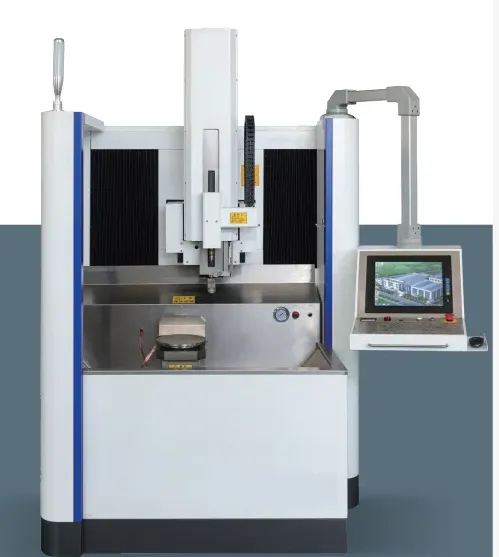 Read More

Contact Us
Recommended Products
-
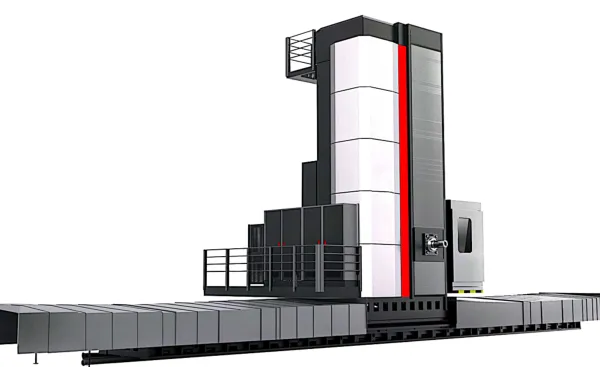
 CNC Boring Machine Horizontal Boring and Milling MachineNegotiableMOQ: 1 Unit
-
Slow Wire Cutting Machine Slow Speed Wire Cutting Machine Made in ChinaUS$ 5500 - 1500000MOQ: 1 Unit
-
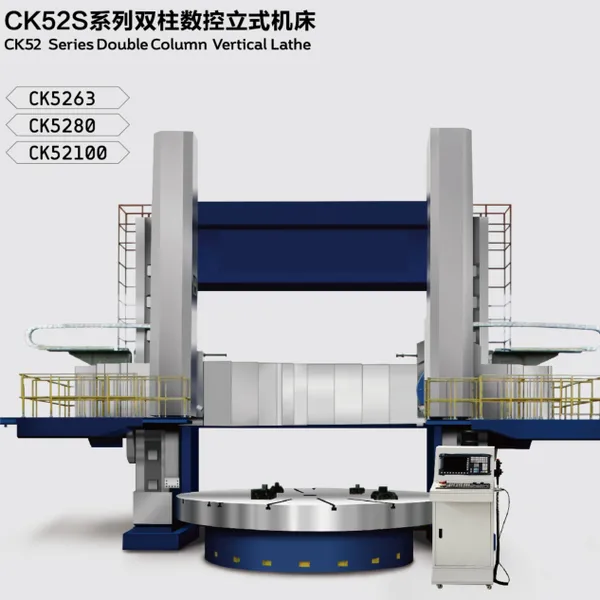
Double Column Vertical Lathe Cnc Vertical Lathe Vertical Turning and Boring MillNegotiableMOQ: 1 Unit
-
Cnc Vertical Lathe Vertical Turning and Boring MillNegotiableMOQ: 1 Unit
-
Cnc Vertical Five-Axis Milling Machining Center Made in ChinaUS$ 48000 - 100000MOQ: 1 Set

-
Cnc Edm Drilling Machine Automatic Wire Feed Made in China 0.15-6.0mmUS$ 5500 - 1500000MOQ: 1 Unit
-
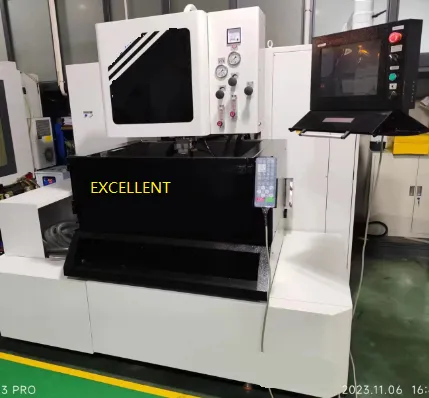
Sevro Moto Wire Cut Machine Cnc Wedm With Larger Taper Made in ChinaUS$ 5500 - 1500000MOQ: 1 Unit
-
Cnc Milling Machine Made in ChinaUS$ 28000 - 100000MOQ: 1 Set
-
VMC(vertical Machining Centre) CNC Milling MachineUS$ 28000 - 100000MOQ: 1 Set
-
Semi-Automatic Hole Drilling EDM Machine With 0.2-6 mm Electrode, 7 MPa Cooling, 3 kW MotorUS$ 3500 - 500000MOQ: 5 Sets


-
High-Speed Hole Drilling EDM Machine With 12,000 Rpm Electrode Rotation, 1-10 mm Range, IP54US$ 3500 - 500000MOQ: 5 Sets
-
Automatic Hole Drilling EDM Machine, 30 A Pulse Power, 600 mm X-Axis Travel, PLC ControlUS$ 3500 - 500000MOQ: 5 Sets
-
Hole Drilling EDM Machine for Aerospace Turbine Blades, 0.3-2 mm Holes, 5-Axis ControlUS$ 3500 - 500000MOQ: 5 Sets
-
Hole Drilling EDM Machine With 1-Year Warranty, On-Site Technical Training, Standard CompliantUS$ 3500 - 500000MOQ: 5 Sets
-
Hole Drilling EDM Machine, 400 x 300 mm Worktable, 0.01 mm Positioning Accuracy, 220VUS$ 3500 - 500000MOQ: 5 Sets
-
Hole Drilling EDM Machine With 12-Month Warranty, Online Technical Support, Free Remote DiagnosisUS$ 3500 - 500000MOQ: 5 Sets
-
CNC Hole Drilling EDM Machine With 5-Axis Servo Control, 0.3-3 mm Electrode, 380VUS$ 3500 - 500000MOQ: 5 Sets
-
CNC Hole Drilling EDM Machine With 0.005 mm Resolution, 500 mm Z-Axis Stroke, 24 V ControlUS$ 3500 - 500000MOQ: 5 Sets
-
Hole Drilling EDM Machine for Mold Cooling Channels, 0.5-3 mm Holes, 400 mm DepthUS$ 3500 - 500000MOQ: 5 Sets
-
CNC Engraving Machine With Factory Test Report and Standard Compliant, 220V 2.2kW, 12-Month Warranty and Setup SupportNegotiableMOQ: 1 Unit